
Heading Out This Summer? Smart Security Steps Before You Leave
Before you leave for a trip, the four highest-impact things you can do are: test every smoke and carbon monoxide alarm, secure all doors and windows, put your lights on a timer, and let a trusted neighbor know you're away. Done together, these steps protect your home from both the silent threats — fire and CO — and the visible ones, like a break-in. This guide from Universal Security Instruments (USI) walks through each step so you can head out knowing your home is covered.
Test Your Smoke and CO Alarms Before You Go

Start with your life-safety devices. Take five minutes to test every smoke and fire alarm and carbon monoxide alarm in your home. Press the test button on each unit and confirm you hear a clear, full-volume alarm. If a device responds weakly or not at all, replace the battery — or replace the entire unit if it's past its service life — before you leave.
A fire or CO event doesn't wait for you to be home, which is why USI recommends testing alarms monthly and never traveling on a unit you haven't checked.
- Test every smoke alarm — including bedrooms, hallways, and common areas
- Test every CO alarm — especially near the garage, furnace, and sleeping areas
- Replace any alarm with a weak or absent test tone before you leave
- Check the manufacture date on the back of each unit and replace any past its service life
How USI Detection Technology Keeps Working While You're Away
Smoke alarms generally rely on one of two sensor types: ionization sensors, which respond fastest to fast-flaming fires, and photoelectric sensors, which respond fastest to slow, smoldering fires. Because a real house fire can start either way, the most reliable coverage senses both. USI Sensing Plus Multi-Criteria alarms deliver the benefits of both photoelectric and ionization detection in a single unit, with strong resistance to nuisance alarms from cooking or steam.
Replacement Intervals and Safety Standards
Detection only works if your devices are within their rated lifespan. Replace smoke alarms every 10 years, and replace CO alarms according to the unit's rated service life (typically 7 to 10 years — many USI combo alarms are rated for a full 10 years). USI's 10-year sealed-battery alarms are powered for their full service life, so you won't come home to a low-battery chirp after a vacation.
USI alarms are independently tested and certified to recognized UL safety standards — UL 217 for smoke and fire alarms and UL 2034 for carbon monoxide alarms — and many models also meet FHA, HUD, and NFPA requirements. Many jurisdictions require 10-year sealed-battery alarms and specific placement under NFPA 72, so check your local code before you travel.
Set Up Your Camera and Motion Sensor Alerts
If you have a home security camera or motion sensors, configure your alert settings before departure so notifications go straight to your phone. Position cameras to cover key entry points — front door, back door, and garage — and confirm each is online before you leave.
- Confirm cameras are online and app-connected before you leave
- Set motion alerts to send push notifications to your phone
- Adjust sensitivity to reduce false alerts from wind or animals
- Make sure live view is accessible from your mobile device
Put Your Lights on a Schedule
Timed lighting is one of the most effective and affordable deterrents available — a home that looks occupied is far less likely to be targeted. Set exterior lights to come on at dusk, and if your interior lights are timer- or smart-enabled, schedule them on a varied pattern that mimics normal activity.
- Set exterior or porch lights to turn on at dusk and off at dawn
- Use motion-activated exterior lighting near entry points for added deterrence
- Schedule interior lights on a natural, varied pattern — not a fixed loop
- Confirm all timers are set correctly before you leave
Secure Every Door, Window, and Entry Point

It's easy to overlook in the rush of packing, but do a full walk-through of every door, window, and entry point. Sliding glass doors should have a secondary lock or a security bar in the track, and the garage door should be verified fully closed.
- Check all door and window locks, including basement and side entries
- Verify the garage door is completely closed
- Manage delivery instructions so packages don't pile up at the door
- Walk the full perimeter one last time before you go
Smart Door Locks for Travel
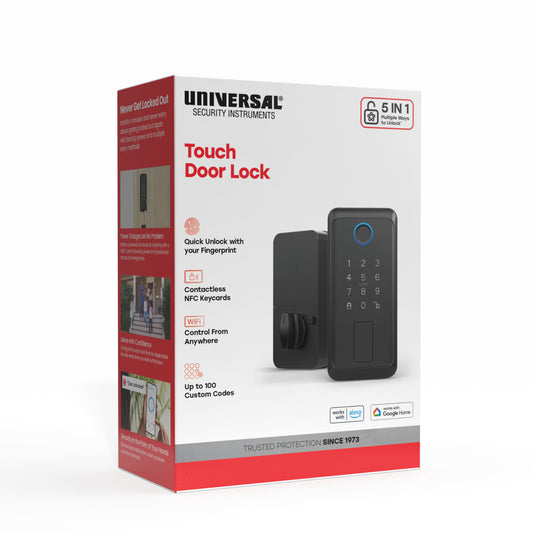
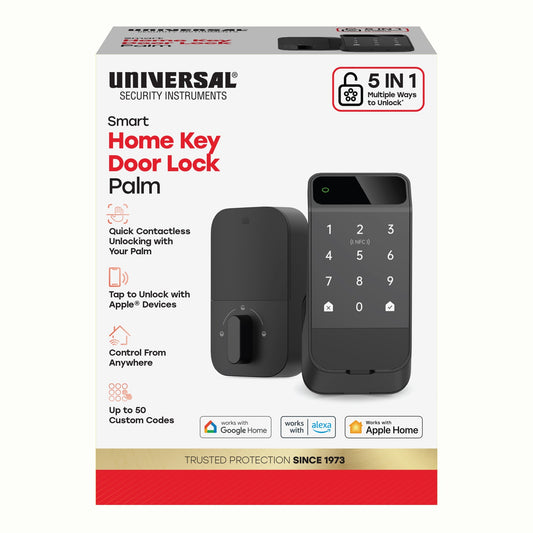
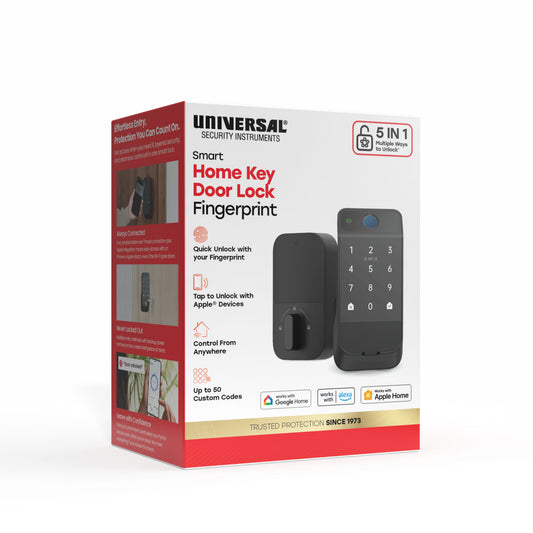
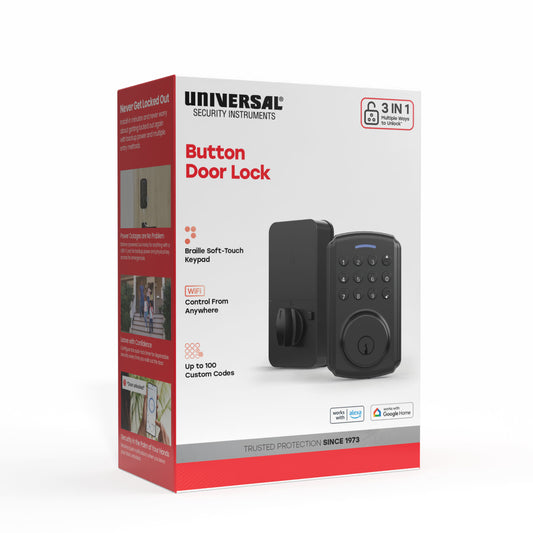
A USI smart door lock makes departure easier and more secure. Set it to auto-lock so the door is never accidentally left unsecured, confirm your access codes are current, and remove any temporary guest or service-provider codes you won't need while you're away. With app access and remote control, you can also confirm the door is locked and grant one-time entry to a trusted neighbor — all from your phone.
Give a Trusted Neighbor Your Contact Information
Technology is only part of a solid plan. Letting a trusted neighbor know you're away — and giving them a way to reach you — adds a layer of awareness no device fully replaces. Ask them to collect mail and packages and keep an eye on things, and share your contact number plus the number for local authorities in case they spot something concerning.
Leave With Confidence
A secure home isn't about fear — it's about preparation. USI has helped families protect their homes since 1973, and the principles are simple: reliable detection, clear alerts, and a few steps taken before anything happens. Run this checklist, and you can step out the door knowing your home is ready for wherever summer takes you.
Make sure your home is covered before you travel. Browse USI smoke and fire alarms, carbon monoxide alarms, and smart door locks, or explore the USI Safety Measures blog for more seasonal safety guidance.